
Intro to Epidemiology: Origins & Triumphs
Lecturio Medical
This video introduces epidemiology, exploring its definition, historical origins with John Snow's cholera investigation, and its triumphs in shaping public health.
Key highlights:
- Differences between descriptive and analytical studies.
- Historical origins of epidemiology and John Snow's work.
- Triumphs of epidemiology in improving society.
- Understanding paradigms of research and knowledge.
内容摘要
核心要点
- 1Epidemiology focuses on the distribution and determinants of health outcomes in populations, distinguishing it from clinical medicine's focus on individuals.
- 2John Snow's work on cholera demonstrated the power of mapping and data analysis in identifying disease sources and informing public health interventions.
- 3Descriptive epidemiology focuses on the who, what, where, and when of disease, while analytical epidemiology examines relationships between exposures and outcomes.
- 4Epidemiological studies can be observational, where researchers observe natural occurrences, or experimental, where researchers manipulate variables.
- 5The etiologic paradigm in epidemiology emphasizes the existence of objective truths about disease causation that can be discovered through scientific methods.
- 6Herd immunity, a concept advanced by epidemiologists, explains how vaccinating a proportion of a population can protect the entire group from disease.
- 7Epidemiology plays a crucial role in disease surveillance, diagnostic test evaluation, trend analysis, and study design, informing public health strategies and interventions.
演示预览
幻灯片内容

Epidemiology is a medical science focused on identifying disease causes in populations. It involves data collection, analysis, and investigation to solve health mysteries, similar to medical detectives. The lecture will cover descriptive vs. analytical studies, historical origins, and triumphs of epidemiology.

Epidemiology is defined as the study of the distribution and determinants of disease or health status in a population. It focuses on the science of looking at the health of populations rather than individuals.
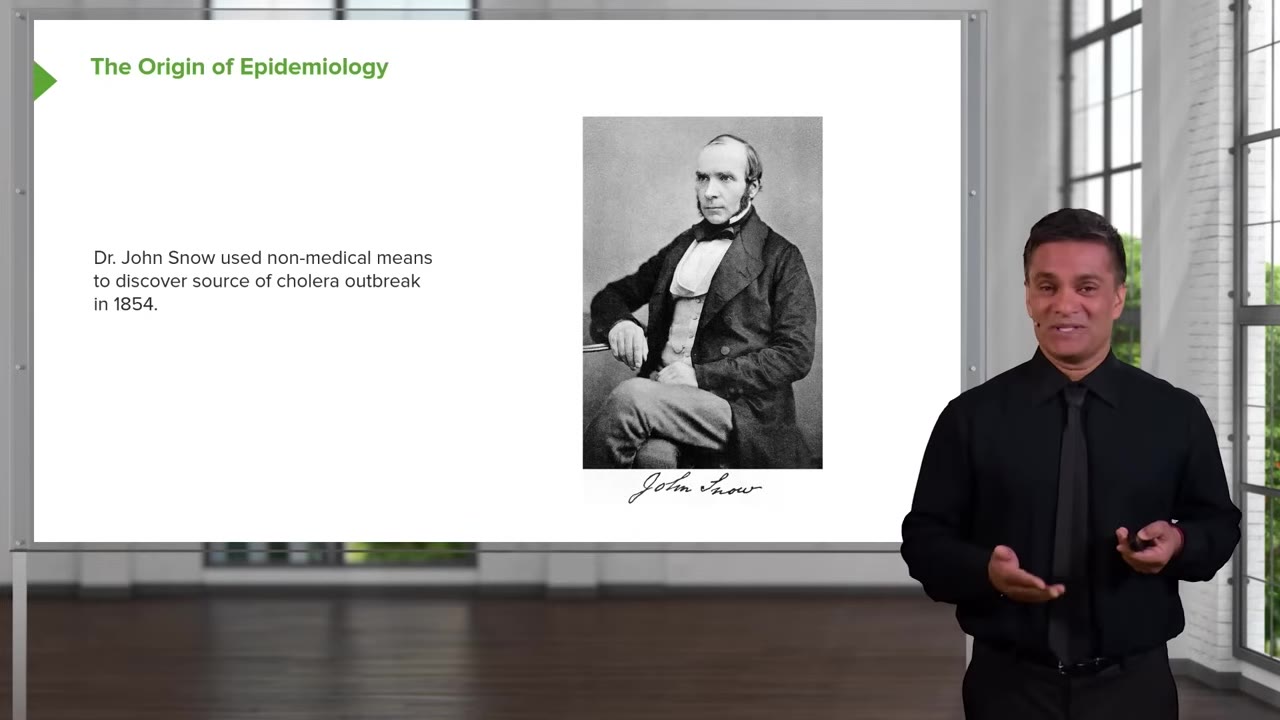
In the 19th century, John Snow investigated a cholera outbreak in London. He used maps and numbers to describe the epidemic, identifying water pumping stations as potential sources. His investigation led him to conclude that the Broad Street pump was responsible for most of the outbreaks.

Before Snow's discoveries, diseases were thought to be caused by miasma, a poisonous vapor. The advent of the microscope allowed for the identification of microbes and pathogens as the true causes of diseases, revolutionizing medical understanding.

Snow collected data on cholera deaths and the number of houses served by different water pumping companies. By calculating the proportion of deaths per house served, he identified the Broad Street pump as the primary source of the outbreak, demonstrating the power of quantitative analysis in epidemiology.

Different types of epidemiologists exist, including outbreak investigators, clinical epidemiologists (who apply clinical experience to patient care), public health epidemiologists (who investigate outbreaks and plan vaccine schedules), and population epidemiologists (who study large disease trends). Epidemiology is increasingly interdisciplinary, partnering with fields like political science, economics, and computer science.
相关资源

Presenting Clinical Research Results Effectively
Axis Lab
COVID-19: What We Think We Know
Axis Lab

Cancer Metabolism: From Molecules to Medicine
Axis Lab

Cardiovascular Research Training Program at UNM
Axis Lab

Tissue Gnostics: Lymphoid Structures & Cancer
Axis Lab

Minamata Convention & Health Sector: Mercury-Added Products
Axis Lab